




There is a particular kind of furniture that does its job so quietly and so well that it rarely gets the recognition it deserves. The side table is one of them. Small enough to tuck beside a sofa or an armchair, unassuming enough to be overlooked in a room tour, it is nonetheless one of the most hardworking and character-defining pieces you can bring into a home. Get it right and it elevates everything around it. Get it wrong and the whole room feels slightly unresolved, even if you cannot immediately say why.
This guide is for anyone who has ever glanced at the space beside their sofa and thought it needed something, without quite knowing what. It is a case for taking this small piece seriously, understanding what it can do, and choosing it with the same care you would give to any significant furniture decision.
What a Side Table Actually Does
On a purely practical level, a beside table gives you somewhere to put things: a drink, a book, a phone, a lamp. That function is real and it matters. But the role this piece plays in a room goes well beyond surface area.
A well-chosen accent table completes a seating arrangement. It signals that the space has been finished, that the room has been thought through to its edges rather than left incomplete at the margins. It creates a sense of balance and intentionality that is felt even by visitors who would never consciously notice the table itself.
It also provides an opportunity for material contrast. In a room anchored by a large upholstered sofa, a small stone or wood table introduces a different texture, a different weight, a different quality of surface that makes the whole space more layered and more interesting. The best interiors are rarely made from a single material. They are conversations between surfaces, and the accent table is often where that conversation begins.
Why Travertine Has Become the Material of the Moment
Among the many materials available for small accent furniture, one has risen above the rest in recent years to become the defining choice of designers and discerning homeowners alike: travertine. And its popularity is not a trend. It is a recognition.
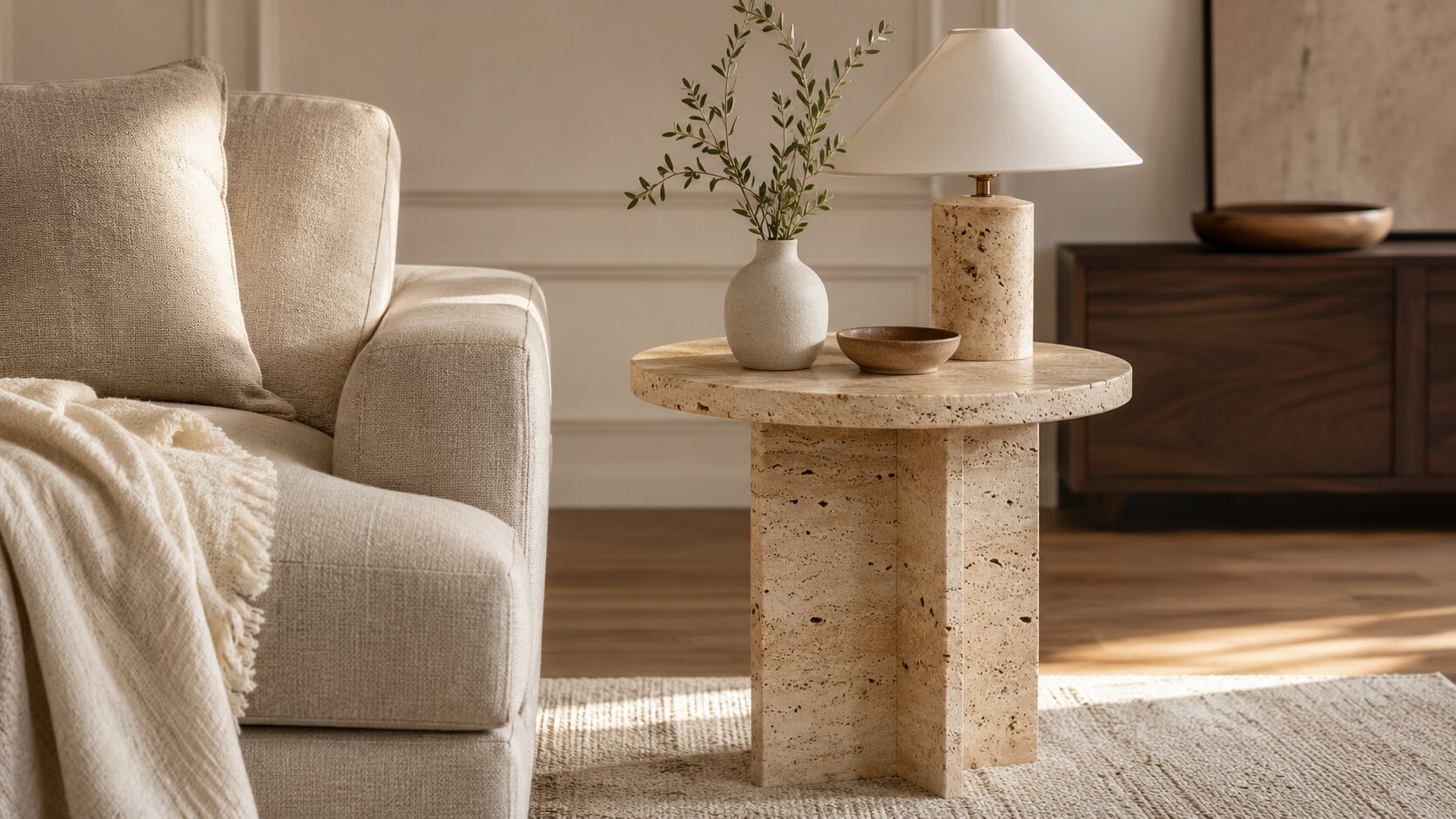
Travertine is a natural limestone formed over thousands of years by the slow deposit of minerals from spring water. Its surface is marked by fine pores, soft veining, and warm tonal variations that range from pale ivory to deep honey. No two slabs are identical. Every piece made from travertine is, by definition, one of a kind.
What makes this stone so compelling in a domestic interior is the quality of presence it carries. It is warm without being heavy. It is textured without being busy. It brings a sense of geological time into a room, a reminder that beautiful things take time to form, and that beauty built on natural processes has a depth that manufactured surfaces cannot replicate.
It also wears exceptionally well. Properly sealed, travertine resists daily use with grace. Minor marks and the subtle shifts that come with age only deepen its character. This is a material that does not need to be protected from life. It simply absorbs it and becomes richer for it.
What Sets a Travertine Side Table Apart
A travertine side table occupies a category of its own among accent furniture. Where a wooden table brings warmth and a glass table brings lightness, stone brings something harder to define: a kind of grounded permanence that makes the rest of the room feel more settled. It sits beside a sofa or armchair with quiet authority, doing nothing to demand attention and everything to reward it.
The scale of a side table is particularly well suited to showcasing stone. Unlike a large dining table or a floor, where the material becomes a background, a small stone piece is intimate enough to be appreciated up close. You see the veining. You notice the variation in tone. You run a hand across the surface and feel the texture. The material is present in a way that feels personal rather than architectural.
Stone accent pieces also offer a level of versatility that surprises people. They read as cool and minimal in a pared-back, neutral interior. They read as warm and grounding when placed beside a velvet sofa or a linen armchair. The material adapts to its surroundings rather than imposing on them, which makes it one of the most flexible choices available.
Choosing the Right Size and Proportion
The most common mistake people make with accent furniture is choosing pieces that are the wrong size for the space. A table that is too tall looks awkward beside a low sofa. One that is too small disappears. Getting the proportion right is not complicated, but it requires a moment of thought before you buy.
Height. The surface of an accent table should sit at roughly the same level as the arm of the sofa or chair it accompanies. This makes it practical to use and visually balanced. The standard range is between 55 and 65 centimeters, but the right height is the one that works with your specific furniture.
Width and depth. A beside table does not need to be large. Its job is to provide a surface, not to dominate the space beside the sofa. Something between 40 and 60 centimeters in diameter or width is usually sufficient. Smaller pieces can look more considered and intentional than larger ones.
Clearance. Leave enough space between the table and the sofa for comfortable movement. You should be able to reach the surface easily without stretching, and the table should not block access to the seat beside it.
How to Style a Stone Accent Table
A stone piece is already a statement. The objects you place on it should complement it rather than compete with it. Less is almost always more.
A lamp. A table lamp beside a sofa or armchair is one of the most useful and most beautiful things in a room. The warm light it casts in the evening transforms the atmosphere of the space. Choose a base with some visual weight, ceramic or metal, to hold its own against the stone surface.
One or two objects. A small vase, a sculptural candle holder, a single piece of found stone or ceramic: the table surface is not a shelf. It is a composition. Give it room to breathe.
Nothing at all. A beautiful stone surface needs nothing on it to be worth looking at. If you have chosen the piece for its material, let the material speak.
Where to Use an Accent Table Beyond the Living Room
The beside table is most commonly associated with the living room, but its usefulness extends throughout the home.
The bedroom. A stone accent piece beside the bed offers a considered alternative to the standard bedside table. Its surface is cool to the touch, its presence calming. It works particularly well in bedrooms that lean toward the minimal and the serene.
The hallway. An entrance hall with a small accent table immediately feels more finished and more welcoming. A lamp, a small tray for keys, a single stem in a narrow vase: the table gives the entrance a sense of ceremony that bare walls and floors cannot provide.
The home office. Beside a reading chair or a desk, a small table keeps the things you need close without cluttering the main work surface. In a room that risks feeling purely functional, a piece of natural stone introduces beauty without distraction.
Natural Stone in the Context of the Wider Interior
One of the reasons stone accent furniture has become so enduringly popular is that it works across a wide range of interior styles without looking forced. It is not a piece that announces a particular aesthetic. It is a piece that enriches whatever aesthetic is already present.
In a minimalist interior, stone brings texture and warmth to what might otherwise feel cold. In a maximalist interior, it provides a moment of quiet among the pattern and color. In a traditional interior, it connects the space to something older and more enduring than any particular period of design. In a contemporary interior, it signals a preference for the real over the replicated.
This adaptability is not accidental. Natural materials have always sat comfortably in human spaces because they share something with us: they are imperfect, variable, and made by processes larger than any individual intention. That quality is increasingly rare in the designed world, and increasingly valued.
Petra Madalena: Pieces Made with Genuine Care
Petra Madalena was built around a conviction that furniture should be worth keeping. Not worth keeping for a few years, until something newer arrives, but worth keeping indefinitely, because it was made from materials and with craft that genuinely justify the long term.
Every stone piece in the collection is selected for the quality of its material, the consistency of its finish, and the integrity of its construction. The sourcing is careful. The finishing is done by hand. The proportions are refined through experience rather than arrived at by algorithm. The result is furniture that sits differently in a room from anything mass-produced, because it was made differently.
Petra Madalena works with natural travertine, marble, and other stone varieties, each chosen for the particular qualities it brings to a domestic interior. The range of accent and side pieces reflects an understanding that small furniture can carry significant visual weight when it is made well, and that quality at this scale is just as important as quality in a larger piece.
For those looking for an accent table that will still look right in twenty years, the Petra Madalena collection is worth exploring in full.
What to Consider Before You Buy
What is the height of my sofa arm? Measure before you commit. The right height makes the piece practical. The wrong height makes it awkward, however beautiful it is.
What other materials are in the room? Stone works best when it has something to contrast with. A room of all-hard surfaces can feel cold. A room of all-soft surfaces can feel ungrounded. Stone adds weight and texture without overwhelming.
How much surface do I actually need? Be honest about how you use the space beside your sofa. If it is just a lamp and occasionally a drink, a small piece is the right choice. Resist the temptation to buy larger than necessary.
Am I buying for now or for always? Natural stone is a long-term choice. If you are still finding your aesthetic, something less permanent might make more sense for now. If you know what you want, stone will never let you down.
A Small Piece Worth Getting Right
The accent table beside your sofa or armchair is one of those pieces of furniture that you will interact with every single day without ever really thinking about it. Until it is wrong. Then you will think about it constantly.
Choosing a piece made from a material as honest and as enduring as natural stone is one of the quietest and most satisfying decisions you can make for your home. It will not shout. It will not demand attention. It will simply be there, every evening, doing exactly what a beautiful piece of furniture should do: making the room feel complete.