





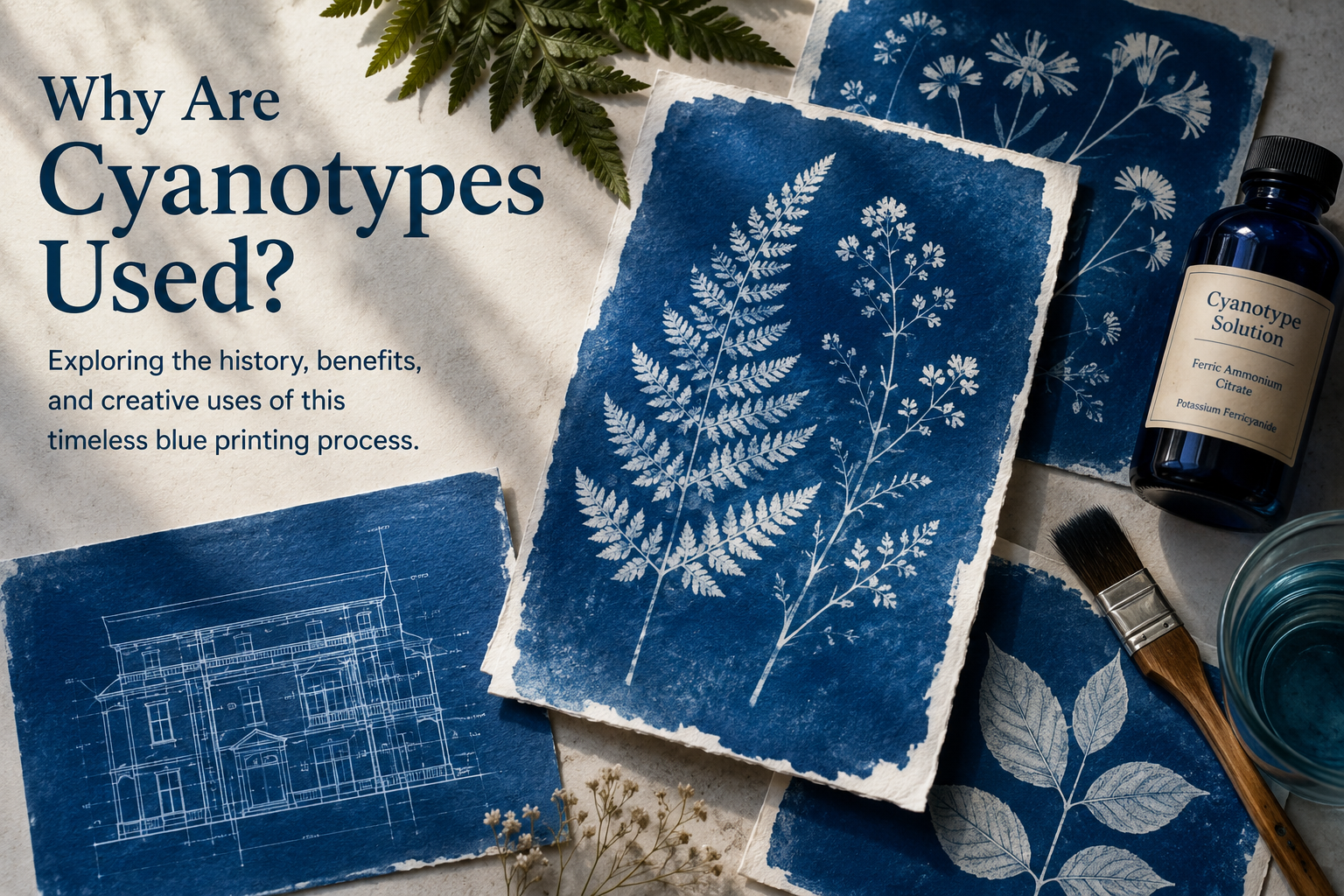
Cyanotypes are used because they offer a simple, creative, and visually distinctive way to produce photographic images. Recognized by their rich blue-and-white appearance, cyanotypes have remained popular for more than a century. Although the process was originally developed for scientific and technical purposes, it is now widely used by photographers, artists, designers, educators, and craft enthusiasts. Its accessibility, affordability, and unique results make cyanotype printing valuable in both practical and artistic settings.
The cyanotype process was invented in 1842 by English scientist and astronomer Sir John Herschel. He discovered that certain iron salts became light-sensitive when mixed together and exposed to ultraviolet light. After exposure, the treated surface could be washed in water to reveal a permanent blue image. This distinctive color, often called Prussian blue, became the defining feature of cyanotype prints.
One of the earliest reasons cyanotypes were used was to reproduce scientific specimens. British botanist Anna Atkins placed algae, ferns, and other plants directly onto chemically treated paper before exposing them to sunlight. The resulting images preserved the shapes, patterns, and fine details of the specimens. Her work demonstrated that cyanotypes could be used for scientific documentation while also producing beautiful images. Today, artists and naturalists continue to use similar methods to record leaves, flowers, feathers, and other organic materials.
Cyanotypes also became important in architecture and engineering. Before modern photocopiers and digital printers existed, the process was used to make copies of technical drawings. These copies became known as blueprints because they usually displayed white lines against a blue background. Cyanotypes provided a relatively fast and inexpensive way to reproduce building plans, machine designs, maps, and construction documents. Although digital technology has replaced traditional blueprint production, the word “blueprint” is still commonly used.
Another major reason cyanotypes are used is their simplicity. Traditional photographic processes may require cameras, enlargers, darkrooms, or complicated chemical development. Cyanotype printing requires fewer materials and can often be completed with sunlight and water. A light-sensitive solution is applied to a surface, an object or negative is placed on top, and the material is exposed to ultraviolet light. After washing and drying, the image becomes visible.
Artists appreciate cyanotypes because each print can have a handmade and unpredictable quality. Changes in sunlight, exposure time, chemical application, water temperature, and paper texture can influence the final appearance. Small imperfections, brush marks, and uneven edges often add character rather than reduce the print’s value. For this reason, cyanotypes are commonly used in experimental photography, mixed-media artwork, collage, bookmaking, and textile design.
The process is also flexible because it can be applied to different materials. While many beginners use cyanotype paper, images can also be created on cotton fabric, watercolor paper, wood, and other absorbent surfaces. This flexibility allows creators to produce wall art, clothing, bags, greeting cards, journals, decorative fabrics, and personalized gifts. Digital photographic negatives can also be used, making it possible to combine modern photography with a historic printing technique.
Cyanotypes are especially useful in education. The process introduces students to basic ideas about chemistry, light sensitivity, exposure, photographic negatives, and image composition. Because objects can be arranged directly on the treated surface, students can experiment without needing advanced photography skills. The washing stage also provides an immediate and memorable transformation as the image gradually develops into a strong blue print.
Environmental and financial considerations also contribute to the process’s popularity. Cyanotype materials are generally affordable, and the prints can be developed with ordinary water rather than a large collection of photographic chemicals. However, users should still handle the solutions responsibly, follow product instructions, wear suitable protection, and dispose of unused chemicals properly.
Modern creators use cyanotypes because the technique connects history, science, nature, and personal expression. Some people value the process for its educational benefits, while others are attracted to its deep blue color and handmade appearance. Designers may use it to create patterns, photographers may use digital negatives, and botanical artists may preserve the outlines of plants.
Ultimately, cyanotypes are used because they transform simple materials into striking and lasting images. The process is easy enough for beginners yet flexible enough for professional experimentation. Its combination of accessibility, historical importance, scientific value, and artistic beauty ensures that cyanotype printing continues to remain relevant in the modern creative world.