




If you were born in Ukraine or lived there for a long time, sooner or later an immigration authority may ask you for a Ukrainian police certificate. Canada requests it for permanent residence, the United States for a green card, Germany and Poland for residence permits, Australia for citizenship. For people who no longer live in Ukraine, the main question is not whether the document exists, but how to obtain a version that a foreign authority will actually accept.
What the document is called
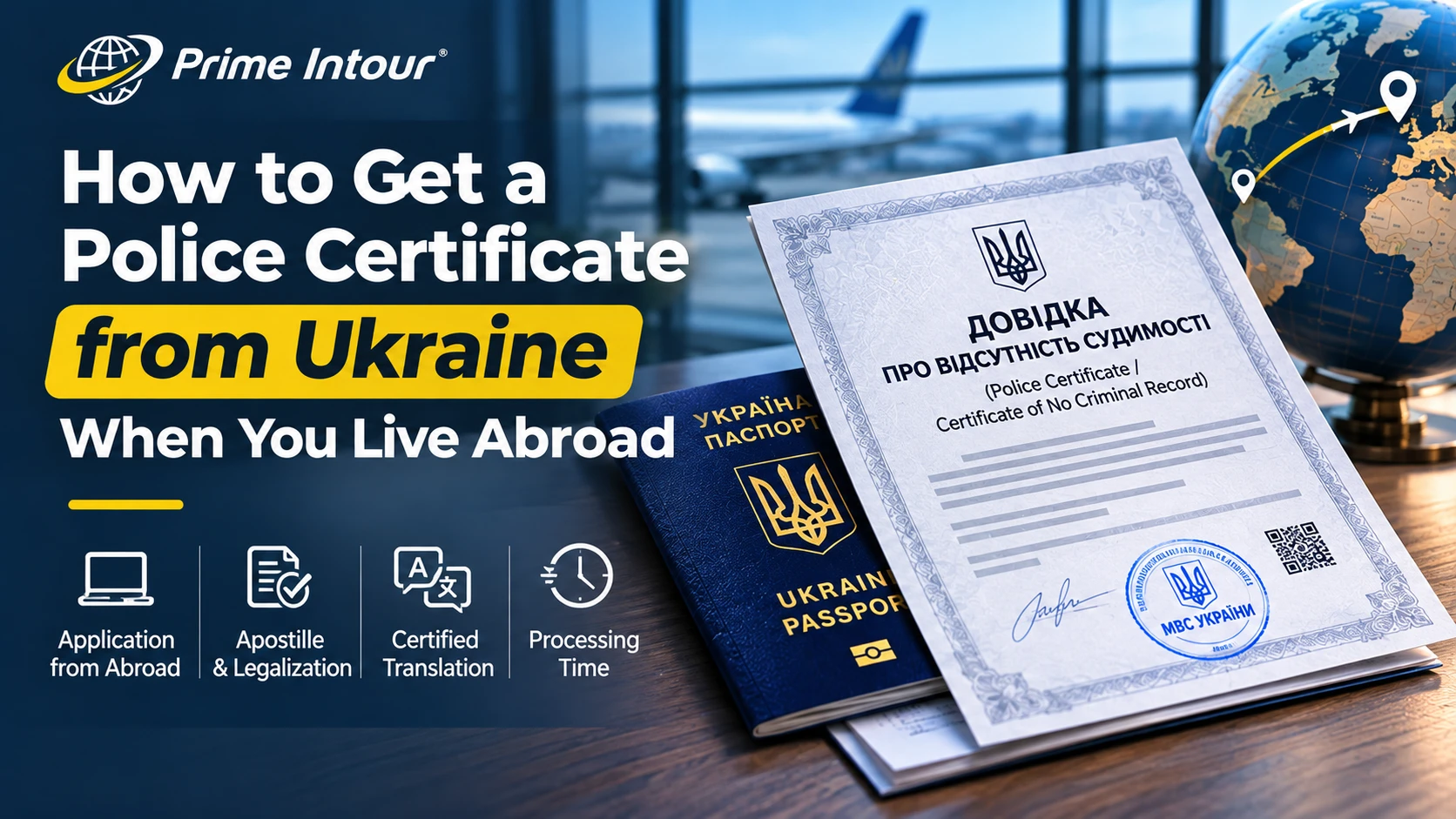
Officially, the document is an extract from the Ministry of Internal Affairs information system that records criminal liability and convictions. In practice it is known as a police clearance certificate, criminal record certificate or certificate of no criminal record. Foreign authorities generally use these names for the same document.
There are two versions. A short extract shows only current convictions, while a full extract shows the complete history, including convictions that have been expunged. Immigration services such as those of Canada, Australia and the United States usually require the full version, so check this before you order.
Electronic or paper with a stamp?
Ukrainians can generate an electronic extract online, and for domestic purposes that is often enough. Abroad, however, authorities frequently require a paper original with a live stamp. That is the version that receives an apostille and that consulates and immigration offices accept. If you are outside Ukraine, collecting the paper original in person is difficult, which is why most people use a representative.
Apostille and translation
Most countries that are parties to the Hague Apostille Convention expect the certificate to carry an apostille. In Ukraine the apostille on a police certificate is issued by the Ministry of Internal Affairs and usually takes about one working day once the paper original is available. After that, the document is translated into the language of the destination country. Depending on the authority, the translation may need to be certified, notarised or done by a sworn translator in that country.
How long the certificate is valid
Ukraine does not set a validity period for this purpose; the receiving authority does. Many authorities only accept a recently issued certificate, often no older than a few months. If you order it too early, it may expire while you are still gathering other documents, so it is best to request it close to your submission date.
Common reasons for rejection
• a short extract was submitted where a full one was required;
• an electronic printout was sent instead of a stamped paper original;
• the apostille is missing or was placed on a copy;
• the translation was not done by the type of translator the authority requires;
• the certificate expired before the application was filed;
• the Latin spelling of the name in the translation differs from the passport.
The last point causes more trouble than people expect. If your passport uses a non-standard transliteration of your name, the translator must use exactly that spelling. Otherwise, an officer may conclude that the document belongs to someone else.
Which countries ask for it most often
The most frequent requests come from immigration authorities. Canada asks for a police certificate as part of permanent residence and some temporary applications; the United States requires it for immigrant visas; Germany, Poland and other EU countries may request it for residence permits; Australia asks for it during citizenship and visa processing. Employers in education, healthcare and finance, adoption agencies and licensing bodies also ask for it.
Requirements can differ even within one country. An immigration authority may insist on a full extract with an apostille and a sworn translation, while an employer may accept an electronic version with an ordinary translation. It is worth getting the requirement in writing or finding it on the official website of the authority.
How long the whole process takes
Generating the extract itself is quick, but preparing it for use abroad involves several steps: the paper original, the apostille, the translation, possibly notarisation, and international delivery. The apostille usually takes about one working day and a translation of a standard document one or two days. Delivery is typically the longest stage, so plan the timeline so that the certificate does not become outdated before you submit it.
Getting it done remotely
For people living abroad, the most practical option is to have one provider handle the whole chain: obtaining the paper original, the apostille and the translation. This avoids sending documents between different cities and contractors, and the finished set is delivered to you by post or courier. You can order a police certificate from Ukraine fully online, with the format tailored to the country where you will submit it.
A quick checklist
• ask the receiving authority whether it needs a full or short extract;
• confirm whether an electronic document is accepted or a paper original is required;
• check whether an apostille and a translation are needed, and who must translate;
• find out how recent the certificate must be;
• have a scan of your passport ready so that names match in the translation.
A police certificate is a small document, but an entire immigration case can depend on it. A few minutes spent confirming the requirements in advance can save weeks of waiting and the cost of ordering it twice.